
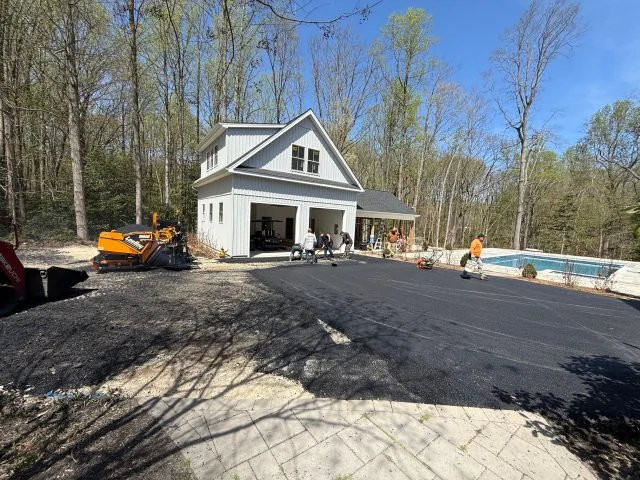
How Long Before You Can Drive on a New Asphalt Driveway?
Usually 24 to 48 hours before you drive on it, longer in summer heat. Full curing takes months, and what you do during that first season decides how the edges and the surface look for years.
The short answer
Wait about 24 to 48 hours before you drive on a new asphalt driveway, and longer if it is hot out. Your crew should give you a specific number for your job, because it depends on the temperature that day, how thick the mat is, and how much shade the driveway gets. In cool weather asphalt sets up faster. In a Maryland August, the surface can stay soft well past a full day, and shaded sections cool at a different rate than sections in direct sun.
Cooling is not the same as curing
These get mixed up constantly, so it is worth separating them. Cooling is what happens in the first day or two, when the asphalt drops from placement temperature down to ambient and becomes firm enough to carry weight. Curing is the much slower process of the oils in the binder hardening, and that takes something like six to twelve months. A driveway can be perfectly safe to drive on and still be soft enough to scuff, mark, or take an impression. Knowing that is the difference between a driveway that looks sharp in year three and one with a permanent set of tire ruts by the first winter.
First season rules that actually matter
Do not turn your wheels while the car is stopped. Power steering against a stationary tire twists the surface and leaves scuff marks that do not come out. Roll a little as you turn. Do not park a motorcycle or a bicycle on its kickstand without a plate or a piece of plywood under it, because the whole weight goes through a contact point the size of a coin. Same for trailer tongue jacks, jack stands, and dumpster feet. Do not park a heavy vehicle in the exact same spot every day for the first summer if you can avoid it. And keep sharp turns off the fresh edges.
Heat, shade, and the first summer
Asphalt softens in heat. That is normal and it is not a defect, it is how a flexible pavement behaves. It means a new driveway is most vulnerable during its first hot stretch, which in Maryland runs from roughly June into September. On a very hot afternoon, a fresh driveway can take an impression from a heavy static load that the same driveway would shrug off in October. If you have a boat, a camper, or a work trailer, the first summer is the time to be thoughtful about where it sits and to put plywood under jacks and tongues.
Edges need the most protection
The edges are the thinnest part of any driveway and they have no lateral support. Running a wheel off the edge onto the grass while the asphalt is still green is the fastest way to create a permanent crumble point. Give the edges a few weeks of grace, and if the driveway is narrow, be deliberate about where your tires go. Some homeowners backfill along the edges with topsoil and seed once the driveway is in, which supports the edge and keeps a wheel from dropping. That is generally a good idea and worth asking about.
Do not seal it yet
New asphalt should not be sealcoated right away. It needs to cure first, generally something like six to twelve months, because the surface still has to release its oils. Sealing too early traps those oils, and you can end up with a soft surface, tracking, or a seal that does not bond properly. Anybody who paves a driveway and offers to seal it the same season is doing you a disservice. After that first cure period, sealcoating every few years is good maintenance. Filling cracks as they show up matters even more.
The first winter
A new driveway handles its first Maryland winter fine, with two things to keep in mind. Use a plastic shovel or a plow with a rubber or poly edge rather than dragging steel across a green surface. And be aware that freeze-thaw cycling is the main stress this climate puts on pavement, so if you see any crack open up in spring, get it filled that season instead of waiting. A crack is how water gets into the base, and water in the base during freeze-thaw is what shortens a driveway's life more than anything else.
What is normal and what is not
Normal: some tire marks in the first hot weeks, a slight softness on very hot days, small aggregate coming loose at the surface early on, and the color lightening from black toward gray over the first couple of years. Not normal: standing water that does not drain, a low spot that holds a puddle after every rain, cracks appearing in the first year, or an area that feels spongy underfoot. If you see any of those, call the contractor who built it and have them look at it. That is a conversation worth having early.
Keep reading
Frequently Asked Questions
Generally 24 to 48 hours, and longer in hot weather. The exact time depends on the air temperature, the thickness of the asphalt, and how much shade the driveway gets. Your paving crew should give you a specific figure for your job and conditions.
Roughly six to twelve months. Cooling in the first day or two makes the driveway safe to drive on, but curing is the slower hardening of the oils in the binder. During that period the surface can still scuff or take an impression from concentrated or static weight.
Power steering turning a stationary tire twists and scuffs a surface that has not fully cured, leaving marks that generally do not come out. Let the vehicle roll slightly while turning the wheel during the first several months.
Wait roughly six to twelve months after installation. New asphalt needs to release its oils as it cures, and sealing too early traps them, which can leave a soft surface, cause tracking, or prevent the sealer from bonding properly. After that, sealcoating every few years is appropriate.
Yes. Asphalt is a flexible pavement and softens in heat, which is expected behavior rather than a defect. It means a new driveway is most vulnerable during its first hot stretch, so avoid concentrated static loads such as trailer jacks or kickstands without a plate underneath.