
Asphalt Millings vs Gravel for a Driveway
For long rural lanes in South County and Calvert, millings hold up better than gravel and cost less than hot mix. They also are not a paved driveway, and it is worth knowing exactly what you are getting.
What millings actually are
Asphalt millings are recycled asphalt pavement. When an existing road or lot is milled off before resurfacing, that material gets crushed and reused. So millings are aggregate that still has asphalt binder coating it, which is the whole reason they behave differently from stone. Spread and compacted, millings knit together over time as sun and traffic warm the binder and press it. They will never bind like hot mix laid at temperature, but they get noticeably firmer than loose stone, and that difference is what people are paying for.
How each one behaves over time
Gravel stays loose. Every rain and every tire moves it, so stone migrates to the edges, collects in ruts, and works its way off the driveway entirely. You regrade it, you add more, and you do it again. Millings settle and tighten instead. After a season of traffic and a couple of hot months, a millings lane feels closer to a firm surface than a loose one. It still is not sealed and it is not impervious, and in heavy rain water still moves through and across it. But the material largely stays where you put it, which is the main complaint gravel owners have.
Why this matters on long lanes here
South County and Calvert are full of long driveways. Wooded lanes off Route 256 and Route 258, farm entrances, shared rural drives, properties set well back from the road. Paving a long lane in hot mix is a significant job, and plenty of those lanes do not need it. What those owners usually want is to stop losing stone into the woods, stop the dust, stop the ruts and washboarding, and be able to get a car down it in February. Millings answer that at a fraction of what hot mix costs, which is exactly why they are so common on rural properties around here.
Dust, mud, and washout
Gravel makes dust in the dry and mud in the wet, and on any kind of slope it washes. Millings cut the dust substantially once they have tightened up, and they hold better against washout because the material locks rather than rolls. Neither one is waterproof. On a steep grade in a hard Maryland downpour, water will find a path across any unbound surface, which is why pitch and where water leaves the lane matter as much as the material choice. If a lane washes every spring, the fix is usually drainage first and surface second.
Compaction is the difference between good and disappointing
This is where millings jobs go wrong. Dumped and spread with a box blade and left for traffic to sort out, millings stay loose for a long time and never fully knit. Properly graded and rolled with a compactor, ideally in warm weather so the binder is workable, they tighten up quickly and hold. The base underneath still matters too. Millings over soft ground will pump and rut like anything else would. If somebody quotes a millings driveway and rolling it is not part of the conversation, ask why.
Honest limits of millings
They are not a finished paved surface and they should not be sold as one. The color is a weathered gray brown, not black, though it darkens some in sun. The surface is textured, not smooth, so it is harder to shovel snow off cleanly and harder to sweep. You cannot sealcoat or stripe it. Edges stay soft and will spread over the years unless something contains them. And it needs occasional attention: topping up, regrading a low spot, keeping the crown right. Less work than gravel, more work than asphalt.
When hot mix is worth the upgrade
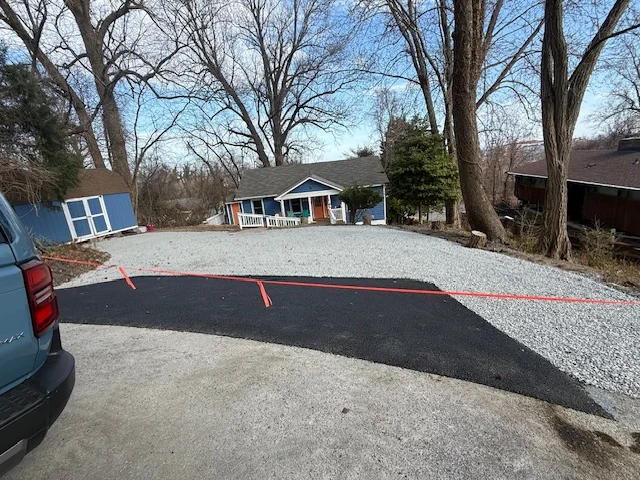
Pave it if you want a clean black finished look at the house. Pave it if you need to plow it easily every winter. Pave it on a steep section where washout keeps beating you. Pave the apron and the parking area even if the rest of the lane stays millings, which is a very common and sensible split: hot mix where it is seen and used hard, millings for the run out to the road. And pave it if the driveway is part of how the property presents, because a finished asphalt driveway does more for a house than any other surface at that price.
How to decide
Ask yourself three questions. How long is it, because length drives cost and changes the math quickly. Does it need to look finished at the house, or does it just need to work. And what is water doing on it today, because drainage problems do not get solved by either material. My honest read for most rural properties here: millings for the long run, hot mix for the apron and the parking area near the house. If you tell me what the lane does and what bothers you about it now, that decision is usually obvious within a few minutes of walking it.
Keep reading
Frequently Asked Questions
Asphalt millings are recycled asphalt pavement. When a road or parking lot is milled off before resurfacing, the removed material is crushed and reused. Because the aggregate still carries asphalt binder, millings knit together over time as sun and traffic work them, which loose stone does not do.
Generally yes, for most rural driveways. Millings compact and tighten over time instead of staying loose, so they produce less dust, resist washout better, and do not migrate off the driveway the way gravel does. They cost more than gravel and far less than hot mix asphalt.
Yes, and this is the most common reason a millings driveway disappoints. Millings that are simply spread and left for traffic stay loose for a long time. Properly graded and rolled with a compactor, preferably in warm weather when the binder is workable, they tighten up and hold much better.
No. Millings are an unbound, textured surface, not a finished pavement, so they cannot be sealcoated or striped. If you want a sealed and finished black surface, that requires hot mix asphalt.
Yes, and it is a common approach on long rural lanes in Southern Maryland. Hot mix asphalt goes on the apron and the parking area near the house, where appearance and snow removal matter most, and millings cover the longer run out to the road.